Allah Help
For the glory of Allah alone

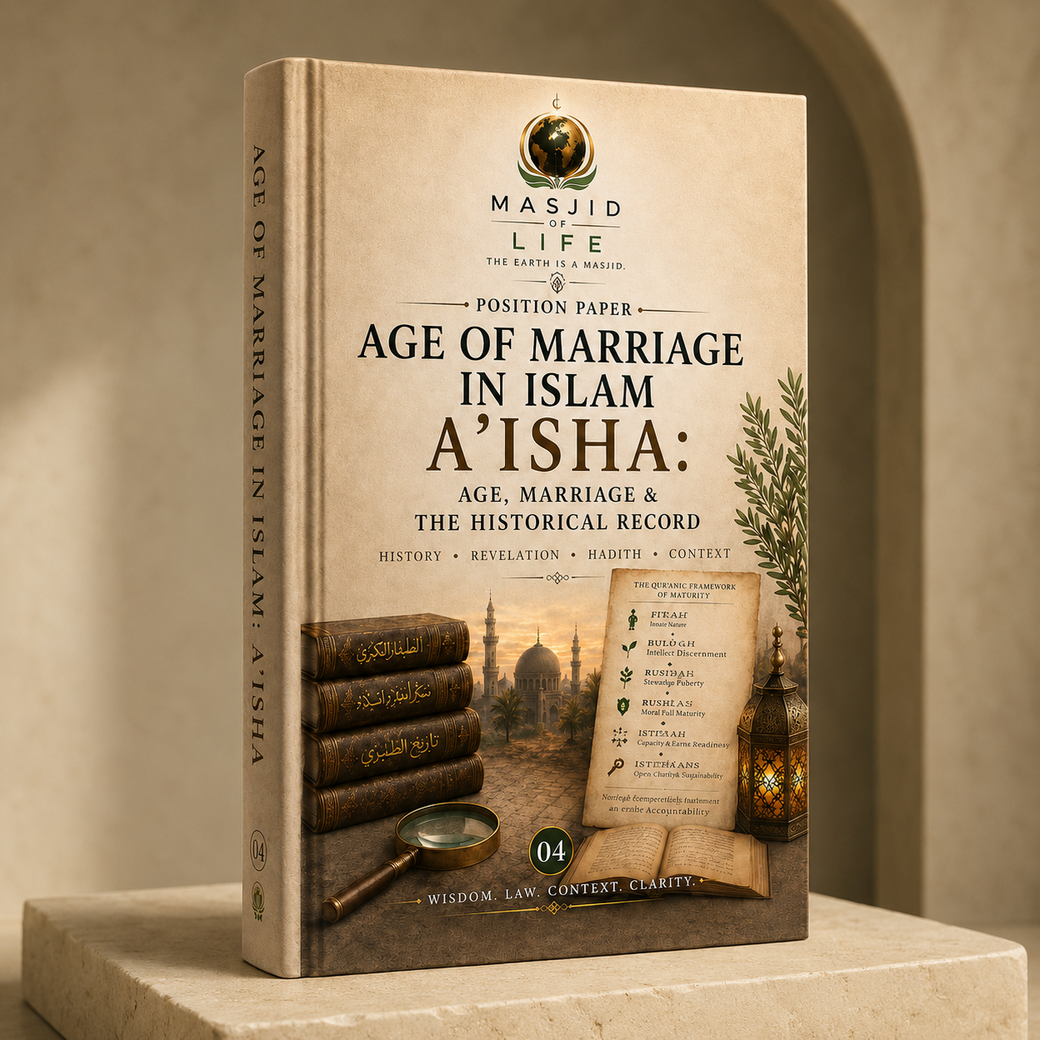
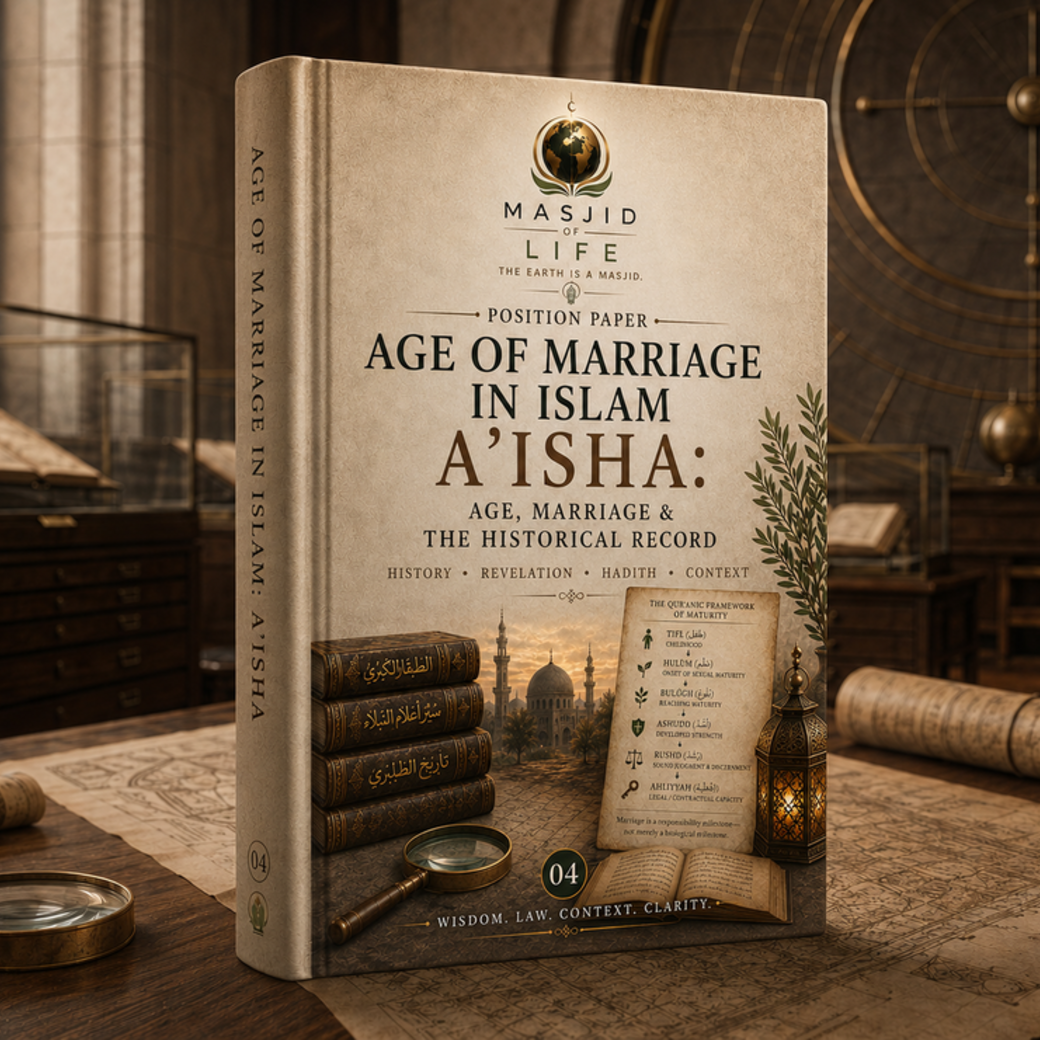
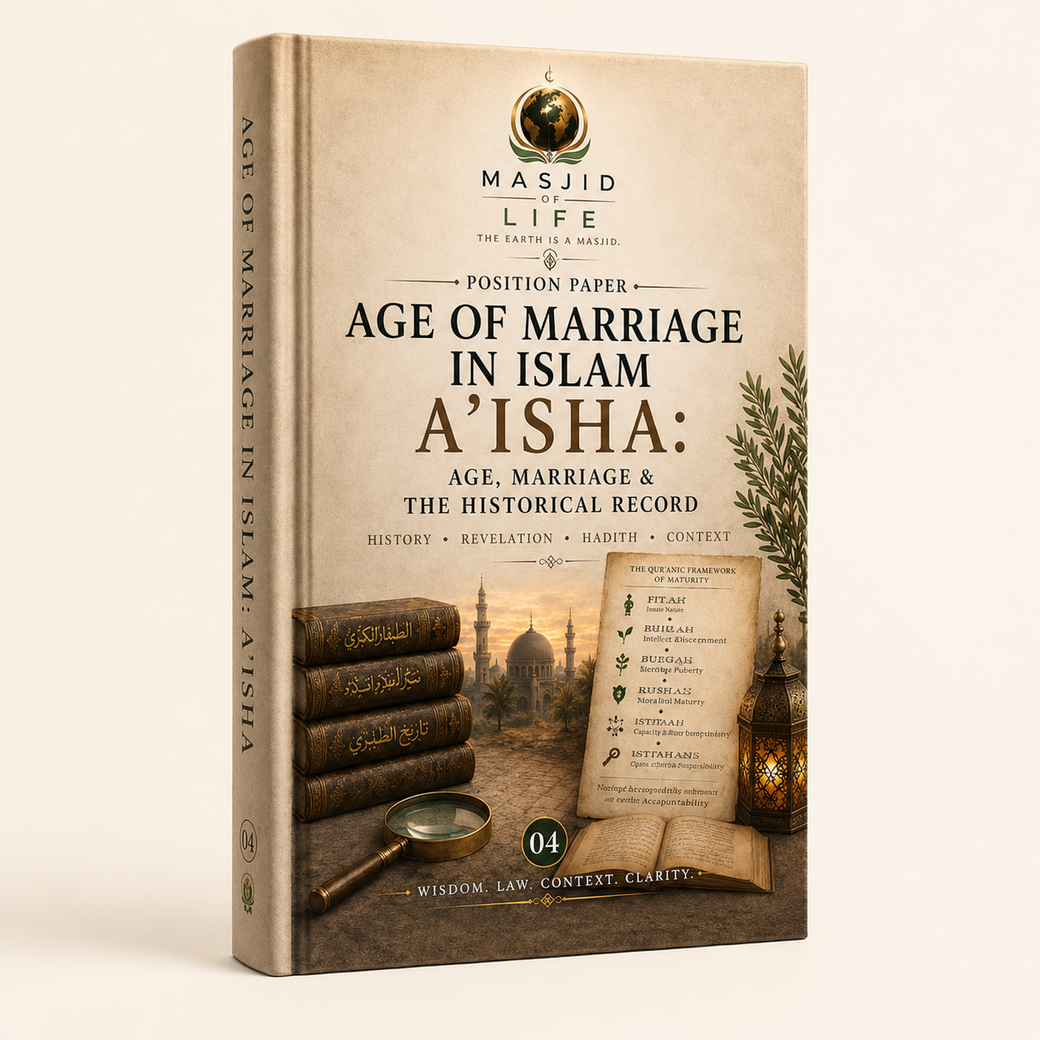
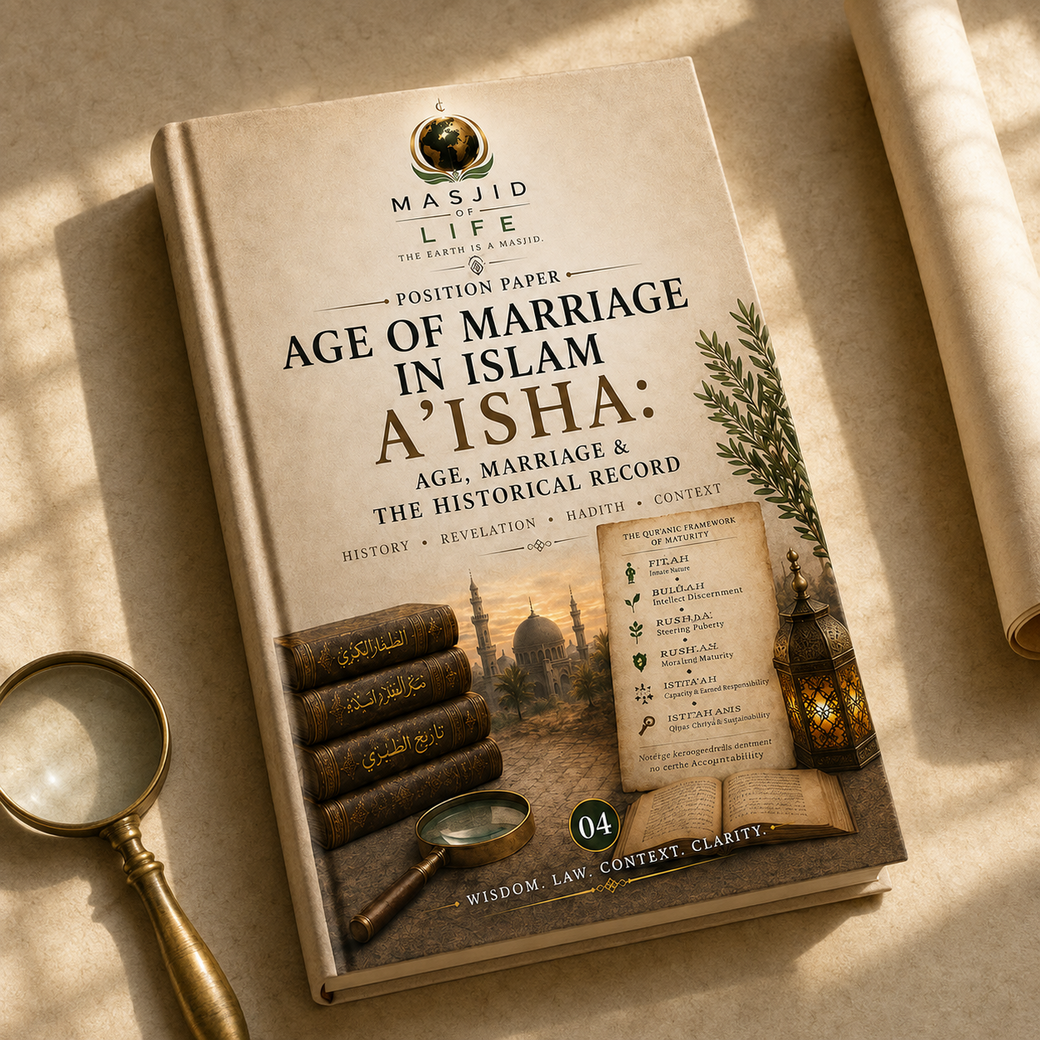
Age of Marriage in Islam

$9.99

What does Islam actually require before a person can bear the responsibilities of marriage—and how should Muslims evaluate the famous report concerning ʿĀʾishah’s age?

Age of Marriage in Islam examines the subject through historical context, Qur’anic developmental principles, Islamic law, hadith methodology, chronology, and the Prophetic model. It distinguishes between childhood, puberty, sound judgment, and legal capacity, and asks whether a solitary probabilistic report can override the Qur’an’s governing framework of maturity, responsibility, welfare, and protection from harm.

The paper presents the Masjid of Life position with clarity: marriage is a solemn covenant requiring maturity, comprehension, consent, responsibility, and legal capacity; child marriage and predatory access to minors have no place in Islam.

THE EARTH IS A MASJID

The Earth has been made for me a masjid and a means of purification.

— Prophet Muhammad ﷺ

QUR'AN 5:2

And cooperate in righteousness and piety, but do not cooperate in sin and aggression.

OUR MISSION

To cultivate a Qur'an-Centered Civilization by producing knowledge, resources, and products that strengthen individuals, families, and communities.

YOUR PURCHASE SUPPORTS

Every purchase supports the Masjid of Life in producing scholarship, educational resources, and community-building initiatives that cultivate a Qur'an-Centered Civilization.

Description

Few questions generate more confusion, defensiveness, and controversy than the age of marriage in Islam and the reported age of ʿĀʾishah bint Abī Bakr (raḍiyallāhu ʿanhā). This position paper approaches the subject neither by ignoring history nor by allowing an isolated report to define the Qur’an’s moral and legal framework.

The study begins by placing early marriage practices within the realities of pre-modern societies, where shorter lifespans, fragile social conditions, and earlier assumption of responsibility shaped family formation. Historical explanation, however, is not the same as religious authorization. The decisive question is what the Qur’an establishes as the ethical and legal foundation for marriage.

From there, the paper examines marriage as a mīthāqan ghalīẓan—a solemn covenant—and traces the Qur’anic developmental progression from childhood to physical maturity, sound judgment, established maturity, and legal capacity. Particular attention is given to bulūgh, rushd, ashudd, and ahliyyah, and to the principle that a binding marriage requires the ability to understand, consent to, and uphold its responsibilities.

The paper then turns to classical law, including discussions of guardian-initiated contracts involving minors. It distinguishes a theoretical contract in form from an actual functioning marriage and emphasizes the juristic requirements of capacity, welfare, harm prevention, and meaningful consent.

The final major inquiry evaluates the famous 6/9 report attributed to ʿĀʾishah. Rather than treating technical hadith grading as equivalent to absolute certainty, the paper examines evidentiary weight, āḥād transmission, chronology, regional transmission, matn criticism, the Prophet’s broader marital pattern, his treatment of children, and the absence of a replicated communal Sunnah of pre-maturity marriage. It also examines what the sources concerning ʿĀʾishah’s prior engagement actually establish—and what they do not.

The Masjid of Life position is stated plainly: the 6/9 narration is rejected as historically reliable, legally authoritative, and morally normative. A solitary probabilistic report cannot overturn the Qur’an’s developmental standards or the Prophet’s established ethic of protecting the vulnerable.

This is not an argument for abandoning hadith. It is an argument for restoring evidentiary hierarchy: revelation governs interpretation, serious claims require proportionately strong proof, and transmitted reports must be weighed within the Qur’an’s framework of truth, responsibility, justice, and moral coherence.

The result is a contemporary, Qur’an-anchored position: no child marriage, no predatory use of religious texts, no exploitation under the guise of tradition—and no reduction of marriage to biology alone. Marriage is a covenant of accountability that requires maturity, judgment, consent, capacity, welfare, and protection from harm.

Reviews

There are no reviews yet.

Be the first to review “Age of Marriage in Islam”

Your email address will not be published. Required fields are marked *