

Description
Some masjids and Islamic scholars teach that conventional commercial insurance is impermissible because of gharar (excessive uncertainty), maysir (gambling), and riba (usury/interest). These concerns are serious and deserve careful examination rather than dismissal.
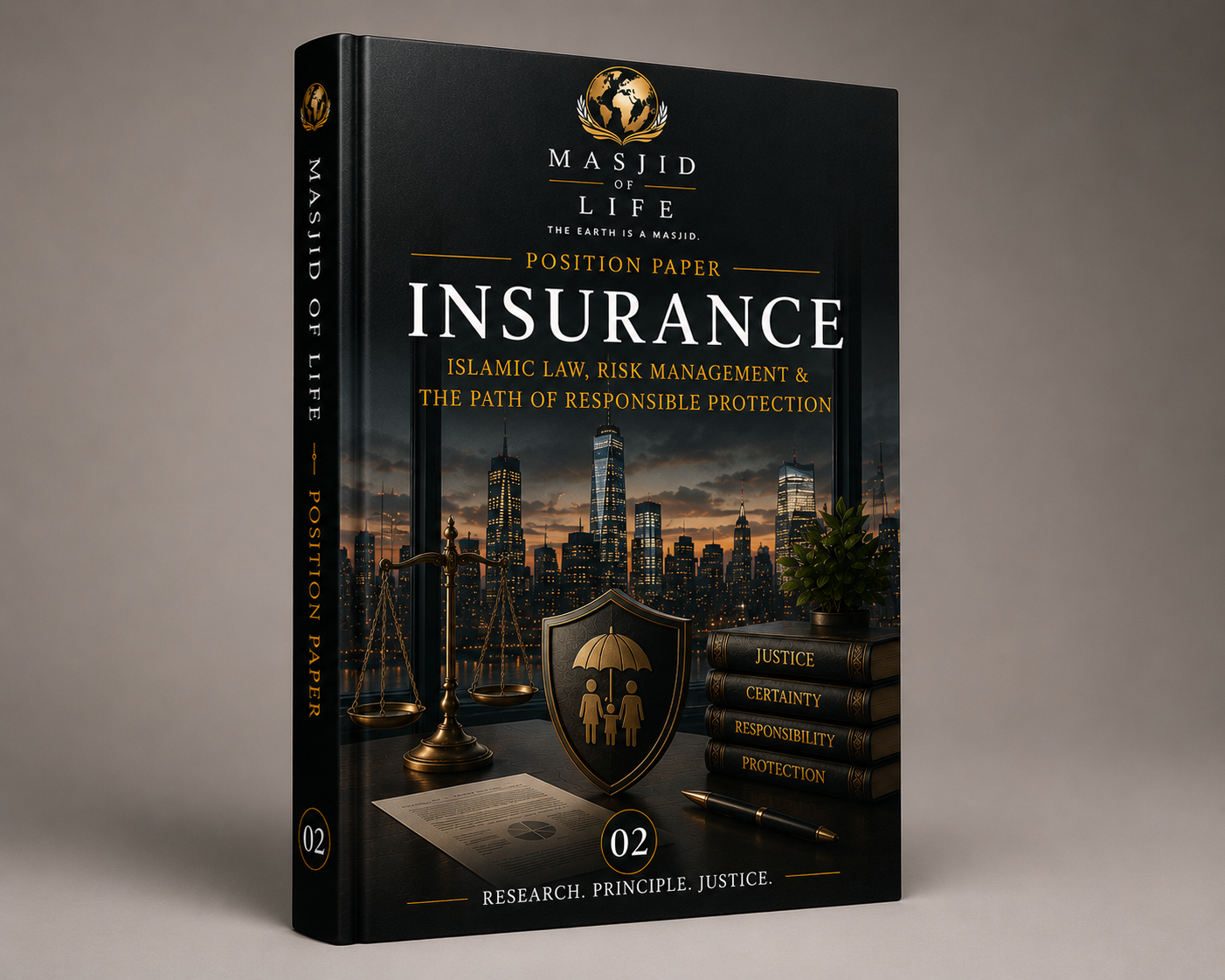
Insurance: Islamic Law, Risk Management & The Path of Responsible Protection begins with those objections and examines the Qur’anic, Prophetic, juristic, and institutional reasoning behind them. It considers why major contemporary fiqh bodies have rejected conventional commercial insurance and why takaful emerged as an alternative model built around cooperation, shared responsibility, and participant-owned risk pools.
The paper then compares conventional insurance, mutual insurance, and takaful in practical terms: who owns the funds, who benefits from surplus, how risk is pooled, how claims are paid, how investments are managed, and where the structures genuinely differ.
Particular attention is given to the realities of modern insurance regulation and actuarial risk management. The paper examines concepts such as insurable interest, indemnity, utmost good faith, solvency, reserves, and legally enforceable claims, asking whether modern regulated insurance should simply be equated with gambling or unbounded uncertainty.
The position advanced by Masjid of Life is clear: insurance itself is not inherently haram. The decisive concerns arise when insurance funds are invested through riba-based institutions, unethical ventures, deception, exploitation, or other prohibited practices. Muslims should support the most ethical and Islamically responsible alternatives available, favor Muslim and Islamic financial institutions where possible, and use conventional options when necessity requires it with awareness and principle.
The paper ultimately moves beyond the question of what Muslims may use today toward what Muslims should build tomorrow: an insurance or takaful institution free of riba, designed to protect families, businesses, wealth, and society while embodying justice, transparency, responsibility, and mutual care.
The goal is not dependency. It is responsible protection—and the building of institutions worthy of our principles.
Reviews
There are no reviews yet.